These are Andrej Karpathy's "Skills"!
Learn AI skills with tools like ChatGPT and Claude to program smarter, safer, and more targeted, reducing errors and over-engineering.

AI That Codes Smarter? Andrej Karpathy’s “Skills” Explained for Non-Developers
AI tools like ChatGPT, Claude, and Cursor can now write entire pieces of software. But anyone seriously using them quickly notices the same problem: the AI often does too much.
It changes code that didn’t need changing. It invents extra features. It refactors half the project. Or it makes assumptions that are completely wrong.
That is why a new trend is emerging among developers: teaching AI discipline through Skills and behavioral rules.
One interesting example is this GitHub repository:
https://github.com/forrestchang/andrej-karpathy-skills
What Exactly Is This?
The repository andrej-karpathy-skills is not a software library, not a framework, and not an AI model.
It is essentially a collection of behavioral guidelines for AI coding tools.
Think of it as:
- a training manual for AI programmers
- a “think before coding” protocol
- a safety framework for AI agents
- a workflow for making AI code more intelligently and predictably
The name references ideas and observations from Andrej Karpathy, former Director of AI at Tesla and one of the best-known AI engineers in the world.
The repository itself was created by Forrest Chang, who translated Karpathy’s ideas into practical AI development rules.
Why Is This Needed?
Every developer using AI tools recognizes these frustrations:
❌ Problem 1 — The AI Changes Too Much
Prompt:
"Make this button blue"

Result:
- New component structure
- CSS refactor
- Extra helper functions
- 12 files modified
AI often tries to be “smart,” but ends up creating unnecessary technical debt.
❌ Problem 2 — The AI Makes Assumptions
Prompt:
"Add authentication"

AI:
- chooses JWT automatically
- creates middleware
- builds refresh tokens
- changes database structure
Without first asking what you actually meant.
❌ Problem 3 — Over-Engineering
AI tends to create solutions that are “too professional”:
- unnecessary abstraction
- design patterns nobody requested
- generic systems for simple problems
So What Do These Skills Actually Do?
The repository tries to make AI agents:
- more careful
- more focused
- simpler
- more controllable
- less chaotic
when generating code.
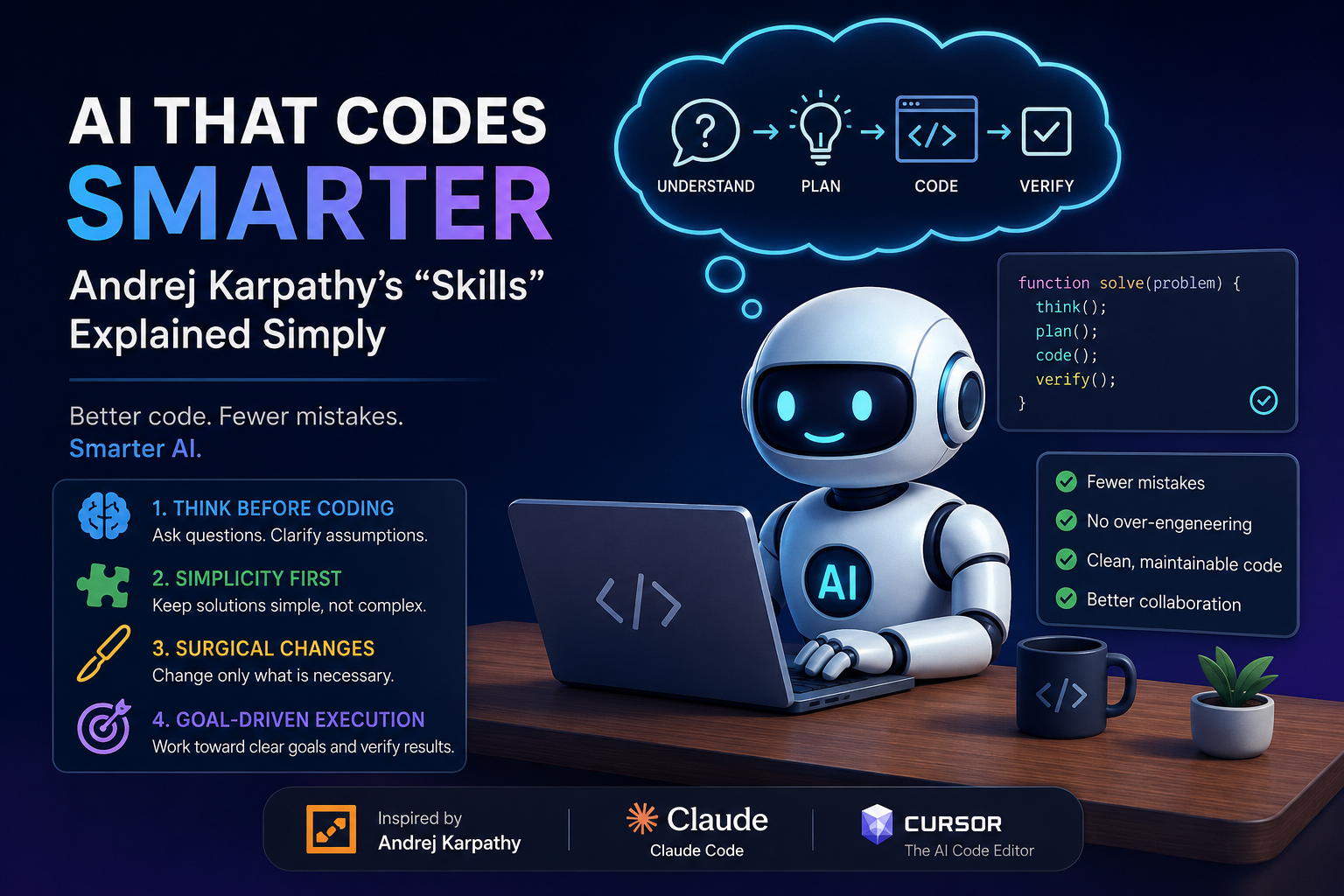
The 4 Core Principles
1. Think Before Coding
The AI should think first before writing code.
Instead of:
"I know what the user means"
It should say:
"These are my assumptions"
"This part is unclear"
"There are multiple possible interpretations"
Example
Bad:
User:
"Build a login system"

AI:
- creates JWT
- uses Redis
- builds OAuth
- creates a complete auth infrastructure
Good:
AI:
"Do you want:
- simple session login?
- JWT API authentication?
- social login?
- Laravel Breeze/Fortify?
"
2. Simplicity First
Keep solutions as simple as possible.
Many AI tools build software as if they are designing systems for NASA. But in reality, most teams want:
- readable code
- maintainable code
- minimal changes
Example
Bad:
AI creates:
- service layers
- repositories
- adapters
- factories
- dependency injection
- interfaces
Good:
Just:
- one function
- clear naming
- directly working code
3. Surgical Changes
Probably the most important rule.
The AI should only change what is necessary.
That means no:
- unnecessary refactoring
- project restructuring
- random formatting changes
- unsolicited “improvements”
Example
Prompt:
"Add a phone number field"
Bad AI output:
- rewrites the entire form component
- adds a new validation layer
- switches UI libraries
Good AI output:
+ input field
+ database migration
+ validation rule
Done.
4. Goal-Driven Execution
The AI should work toward a clearly defined goal.
Meaning:
- what exactly should work?
- how do we verify it?
- when are we finished?
Example
Success criteria:
- user can log in
- session persists
- logout works
- tests pass
This prevents “half-working magic.”
Why This Matters
We are moving toward a world where developers increasingly:
- guide AI
- supervise AI
- correct AI
- orchestrate AI
instead of typing every line manually.
That means the skillset is shifting from:
"How do I code?"
to:
"How do I manage AI programmers?"
What Are “Skills” Anyway?
OpenAI describes Skills as:
“Reusable workflows with instructions, examples, and optional scripts, allowing AI to perform tasks consistently.”
In other words:
You are teaching AI how to behave.
Exactly like mentoring a junior developer.
Think of It Like a Senior Developer
Junior AI AI with Skills Makes assumptions Asks clarifying questions Refactors everything Changes only necessary code Over-engineers solutions Keeps things simple Acts impulsively Works toward clear goals Produces “magic” Produces predictable behavior Why Developers Are Excited About This
Especially in larger projects like:
- Laravel applications
- React frontends
- Python automation
- microservices
- legacy codebases
you do not want AI randomly touching everything.
This approach makes AI:
- safer
- more predictable
- better at collaboration
- less likely to create technical debt
A Real-World Example
Without Skills
Developer:
"Fix this bug"

AI:
- changes 17 files
- updates dependencies
- rewrites components
- breaks tests
With Skills
AI:
"The bug is probably located here.
I recommend changing only this function.
These are the side effects.
These tests verify the result."
That difference is massive.
Useful Links
GitHub Repository
https://github.com/forrestchang/andrej-karpathy-skills
Andrej Karpathy
OpenAI Skills Documentation
https://help.openai.com/en/articles/20001066-skills-in-chatgpt
Claude Code
https://www.anthropic.com/claude-code
Cursor AI
Final Thoughts
This repository may look small and simple, but it actually represents a major shift in software development.
We are moving from:
“AI that writes code”
to:
“AI that learns professional engineering behavior”
And that is probably the future of AI development.
Not just smarter models. But smarter workflows. Smarter limitations. Smarter discipline.
Because the best AI is not the AI that does the most.
The best AI is the AI that does exactly what is needed — and nothing more.