The Secret Engine Behind Smart AI
Agent Harness = model + tools, memory and control. Enhances AI performance by up to 6× through autonomy, context, safety, and real task execution.

The Hidden Engine Behind Smart AI: What is an ‘Agent Harness’ (and why you need it)?
Imagine placing the smartest professor in the world inside an empty room. No pen, no paper, no computer, no memory. No matter how brilliant they are — they cannot complete a single meaningful task. The moment they stop speaking, everything is gone.
This is exactly how a standalone AI model works (like GPT or Claude). It’s incredibly intelligent, but without context, memory, or tools, it’s fundamentally limited.
The solution we’re rapidly adopting in 2026? The Agent Harness.
The new standard formula:
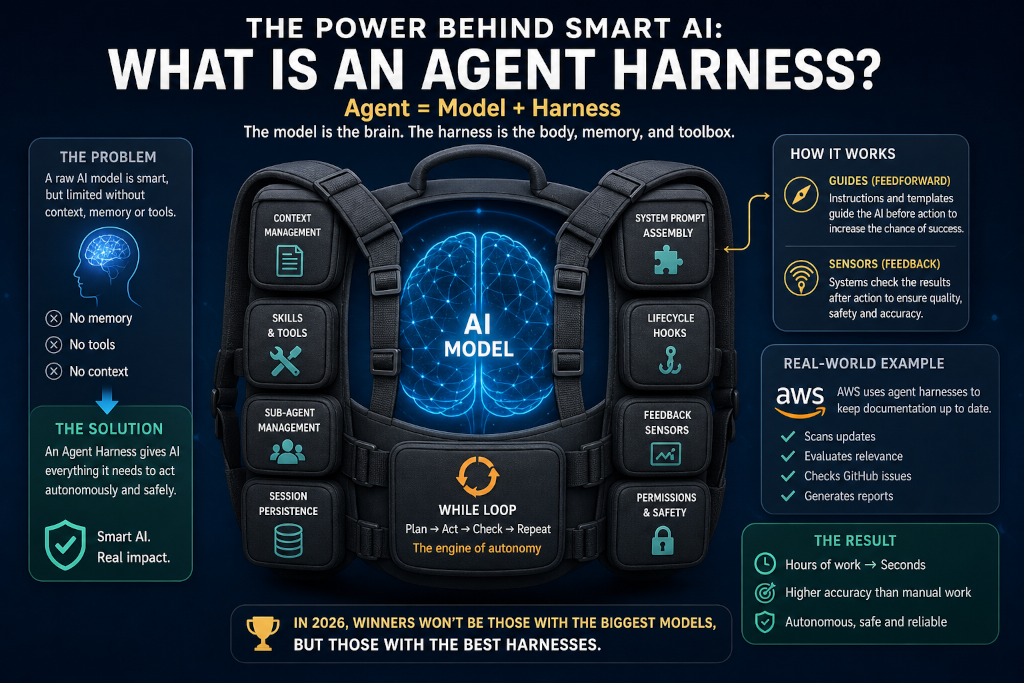
Agent = Model + Harness
The model is the brain. The harness is the body, memory, and toolbox.
Why the Harness Matters More Than the Model
The intuitive assumption is: “We just need a smarter model.”
But research (including from Stanford) shows something surprising:
- The exact same model can perform up to 6x better
- Simply by optimizing the surrounding harness architecture
This means:
- The model is no longer the primary bottleneck
- How you use the model is what truly matters
In fact, a key trend in 2026 is pruning:
👉 Fewer tools often lead to better outcomes
An overly complex harness can actually restrict modern AI systems. Today’s models perform best when given structured freedom within clear boundaries.
Framework vs. Harness: What’s the Difference?
In the early days, we relied on frameworks like LangChain.
- Framework = LEGO box
- You assemble everything yourself
An Agent Harness is fundamentally different:
- Harness = Cockpit
- You define the goal → the system handles execution
The harness operates as an intelligent while-loop:
Plan → Act → Check → Repeat
Including:
- Error handling
- Decision-making
- Safety enforcement
Under the Hood: The 9 Core Components
A robust agent harness in 2026 consists of the following building blocks:
- While Loop (The Engine)
- Drives autonomous iteration until the objective is achieved.
- Context Management (Working Memory)
- Determines what should be retained, summarized, or discarded.
- Skills & Tools (The Hands)
- Access to APIs, databases, the internet, and internal systems.
- Sub-agent Management
- Coordinates specialized AI agents for subtasks (often consuming ~90% of compute).
- Session Persistence (Long-term Memory)
- Ensures continuity — even after crashes or interruptions.
- System Prompt Assembly
- Dynamically injects rules, context, and domain knowledge per task.
- Lifecycle Hooks
- Predefined checkpoints where human intervention is possible (e.g. approvals).
- Feedback Sensors
- Post-action validation mechanisms:
- Automated tests
- Quality checks
- AI-based evaluation
- Permissions & Safety
- Defines boundaries and prevents unintended or unsafe actions.
Controlling AI: Guides vs. Sensors
Because AI is probabilistic (and not always predictable), we guide it using two complementary approaches:
1. Guides (Feedforward)
- Instructions, prompts, and templates given before execution
- Goal: increase the chance of getting it right the first time
2. Sensors (Feedback)
- Validation mechanisms applied after execution
- Examples:
- Pass/fail tests
- AI reviewing output quality
- Business rule validation
Together, they form a closed-loop control system.
Real-World Example: The ‘Zero-Touch’ AWS Agent
Amazon uses agent harnesses to keep documentation continuously up to date.
The agent:
- Scans new updates
- Evaluates relevance
- Checks GitHub issues
- Generates reports
Key insight:
- No rigid, hard-coded logic
- Clear boundaries + the right tools
Result:
- Hours of work → seconds
- Higher accuracy than manual processes
- Fully autonomous within safe constraints
Why This Matters
A well-designed harness does something fundamental:
It digitizes human intuition.
It provides what raw AI lacks:
- Context
- Memory
- Decision structure
- Boundaries
You’re not just giving AI intelligence — you’re giving it operational capability.
Conclusion
The future of AI is not just about better models.
It’s about:
- How you orchestrate them
- How you constrain them
- How you enable them to act
The winners in 2026 won’t be the companies with the biggest models…
…but the ones with the best harnesses.