How Mercury 2 Has Permanently Broken the 'Latency Wall'
Mercury 2 is the first reasoning diffusion language model. By processing text in parallel, it achieves >1,000 tokens/sec, making it perfect for real-time AI.

The Evolution of AI: How Mercury 2 Has Broken the 'Latency Wall' Forever
Anyone who regularly works with AI knows that familiar, little frustration: you type in a complex prompt, hit enter, and then wait. You stare at your screen as the language models type out their response word by word, sentence by sentence. It feels magical, but at the same time, it’s like watching an invisible, rather slow typewriter. For a simple email, that’s not a disaster, but for real-time applications, that waiting time is deadly.
What if I told you that we can finally put that imaginary typewriter out with the trash? Meet Mercury 2, a brand-new language model from the start-up Inception Labs. This model is shaking up the tech world by taking a fundamentally different approach and shattering all existing speed records.
The Typewriter versus The Editor
To understand why Mercury 2 represents such a giant leap forward, we need to take a look under the hood. Almost all known AI models (such as Claude, Gemini, and the GPT series) operate autoregressively. That's a fancy term indicating that they generate text serially: they predict the first word, then the second, and so on. The big downside to this is that this process is inherently slow. Even worse: if the model takes a wrong logical turn halfway, it cannot go back. The mistake is as permanent as ink on paper, causing errors to inevitably accumulate (cascading errors).
Mercury 2 tackles this completely differently by using diffusion technology. This is exactly the same brilliant concept that powers popular image and video generators like Midjourney and Sora. Instead of typing word by word, Mercury 2 starts with a rough sketch of 'noise' and creates the complete text at once. After that, the entire response is refined and polished in a lightning-fast, parallel process.
You can best compare it to a sharp editor who reviews the entire text. If the model makes a mistake somewhere in the middle, it simply goes 'back in time' during a refinement step and corrects those specific words before you even see the final text.
Absurd Speed: More than 1,000 Tokens per Second
Nice theory, but what does this mean in practice? Crystal clear, unprecedented speed. Mercury 2 easily clocks more than 1,000 tokens per second during tests on NVIDIA Blackwell GPUs. To put that in perspective: models specifically built by the competition for speed, such as Claude 4.5 Haiku or GPT-5.2 mini, hover around 70 to 89 tokens per second. Mercury 2 is literally in a completely different weight class.
A bizarre and beautiful example was seen during a test where developers asked to code a working Tetris game, but with the twist that the blocks had to fall upwards instead of downwards.
- Claude Haiku took 1 minute and 24 seconds.
- Gemini 3 Flash failed after 1 minute and 8 seconds by delivering non-working code.
- Mercury 2? It set up the perfectly working game in just 18 seconds.
Another example? Generating a working, browser-based Mac OS interface with SVG icons took the model only 12 seconds. Shorter, end-to-end tasks are even completed in benchmarks in about 1.7 seconds.
Lightning fast, but with Brains (Reasoning)
Speed is obviously worthless if the output doesn’t make sense. The true uniqueness of Mercury 2 is that it is the world's very first diffusion language model that can actually reason. Users and developers can even manually set the ‘thinking power’ to levels such as instant, low, medium, and high.
If you set the model to 'high' for a complex programming task, it thinks deeply and structures its logic. This results in impressive test scores:
- A score of over 90 on the heavy mathematical AIM benchmark.
- Scores in the mid-70s on the GPQA test, which assesses scientific reasoning.
- Perfectly following bizarre instructions, such as writing a coherent story where each sentence must be exactly one word longer than the previous one (from 2 to 20 words, and back).
- Seamless use of built-in tools, such as real-time web searching to fetch the latest facts.
Where Will We Use This in Practice?
Now that the infamous "latency wall" in the AI world has been broken, it opens doors for applications that have previously been too sluggish:
- Fluent Voice Assistants: In spoken customer service via AI, every second of silence is fatal. Thanks to the sub-second response time, a spoken conversation with Mercury 2 suddenly feels incredibly natural, as if you’re talking to a real person.
- Agentic Workflows & RAG: AI agents that perform multiple steps independently (planning, searching for documents, taking actions) often got stuck because each step had to wait for the previous one. By minimizing these wait times, automated processes (like RAG pipelines for data extraction) now work faster and more reliably than ever.
- Realtime Programming: For developers who want to build features or refactor code instantly, this feels like pure magic. You ask for a piece of software, and the code literally appears on your screen almost immediately. This keeps programmers perfectly in their flow.
Created by Heavyweights (and Surprisingly Affordable)
This masterpiece didn’t just fall from the sky. The team behind Inception Labs consists of professors and researchers from top universities like Stanford, UCLA, and Cornell. These people were themselves at the forefront of diffusion technology in the past. Moreover, they have received substantial financial support from tech icons like Andrew Ng, Andrej Karpathy, Microsoft, and Nvidia.
They have ensured that this model is not only incredibly smart but also super accessible for developers. Mercury 2 works as a direct 'drop-in replacement' for the widely used OpenAI API. So, you don’t have to completely rewrite your code. Furthermore, it has a massive context window of 128,000 tokens, and the pricing is aggressively low: just $0.25 per million input tokens and $0.75 per million output tokens.
Experience It Yourself
As an industry, we have tried for years to speed up that slow, sequential model with ever-larger chips and tricks. Mercury 2 proves that we needed to approach the problem fundamentally differently: by completely removing the bottleneck.
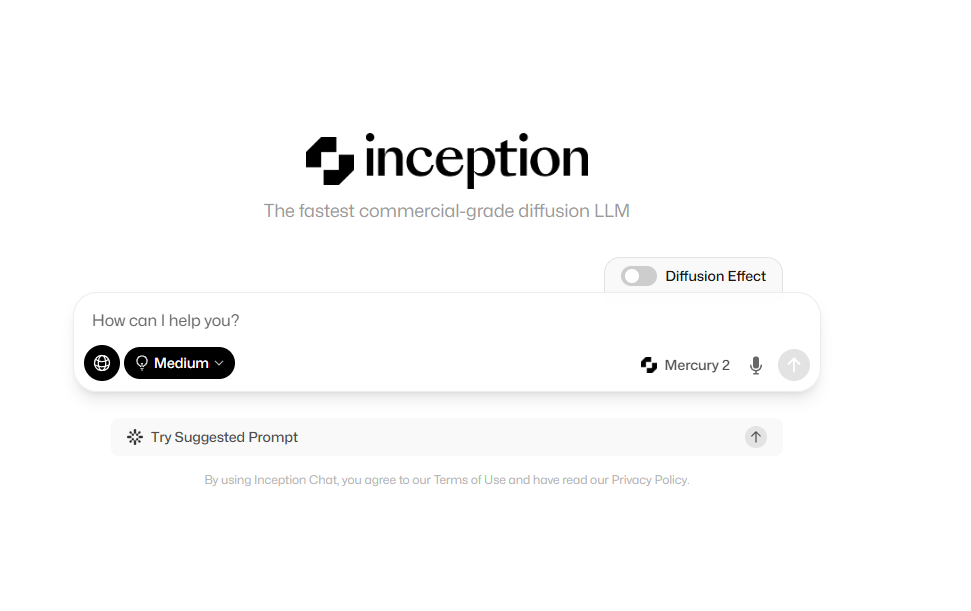
But don’t just take my word for it; you can now directly test the insane speed and reasoning ability of this diffusion approach yourself. Go to https://chat.inceptionlabs.ai/, play around with the different 'reasoning' settings (like instant or high), and experience for yourself what the future of AI feels like. Just be warned: once you get used to this speed, that old AI 'typewriter' will likely feel agonizingly slow!